Thrips Control
Thrips invade when close by areas dry up or are mowed. Best approach is to apply Cucumeris to seedlings weekly for five weeks using a small pile of bulk Cucumeris near the base of each plant. Work towards a 1:1 ratio of Cucumeris to thrips. In certain cultivated crops, with low thrips tolerance, one five-week round gives six to eight weeks of protection. If leaf-pupating thrips like Echinothrips establish, double the Cucumeris to at least 200 per plant right away and put out blue sticky cards with lures or vanilla to draw them away from the plant.
As a preventative measure it can be good to sprinkle Stratiolalaps in the root zone to stop the cycle of soil-pupating thrips, such as western flower thrips and onion thrips. Additionally, nematodes attack soil pupating thrips better than Stratiolalaps (Hypoaspis) in moist media, such as rockwool, but Stratiolalaps (Hypoaspis) will establish more reliably. The combination of Stratiolalaps (Hypoaspis) and beneficial nematodes are the optimal preventative strategy for soil pupating thrips and fungus gnats. Release Orius only when thrips are present. Habitat plants like fennel, coriander or succession corn can provide Orius with a pollen and nectar source and may help establish Cucumeris. Blue or yellow sticky cards will strip adults out of the house if they are laced with thrips lures or vanilla extract.
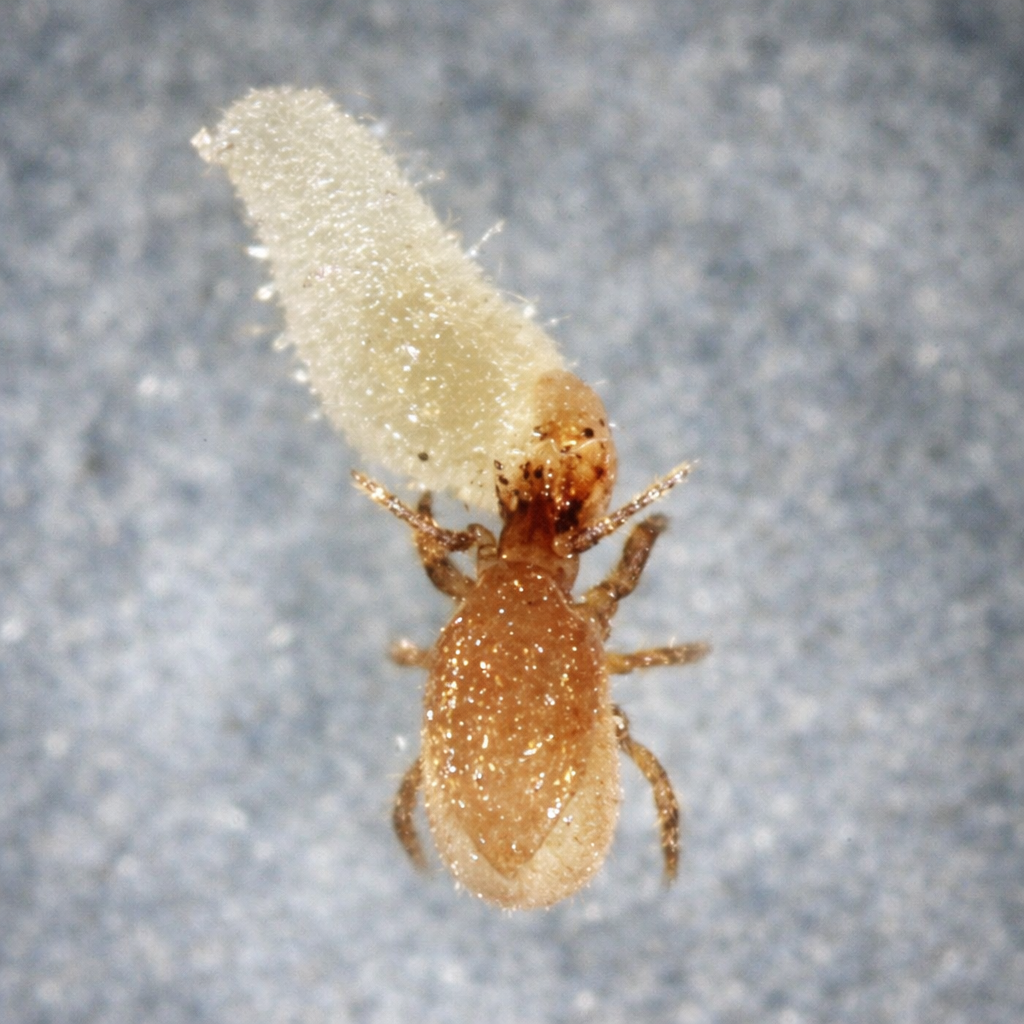
Stratiolaelaps simitus / Hypoaspis miles is a predatory mite that eats larva of fungus gnat. Also feeds on western flower thrips (WFT) pupae and springtail (especially in house plants). Lives in top layer of soil, feeds on small, soil-inhabiting insects, mites and all stages of springtails. Can adapt to many different growth media and capillary mats. No diapause: can be used year round. Active at temps > 54° F . Can survive low pest densities. Helps clean up greenhouses and mushroom production, as well as controlling mites on tarantulas, lizards and bees. Should not be applied to soil that has been treated with lime or copper sulfate mixtures. Atheta is a predator of Stratiolaelaps simitus; Stratiolaelaps simitus eats nematodes, good and bad. 10-13 L per acre OR 50 mites per 10 sq ft. Twice monthly, 2-5 times overall. Most effective applied prior to heavy infestations and for end of crop clean-up.
Shipped Wednesday, order by previous Friday
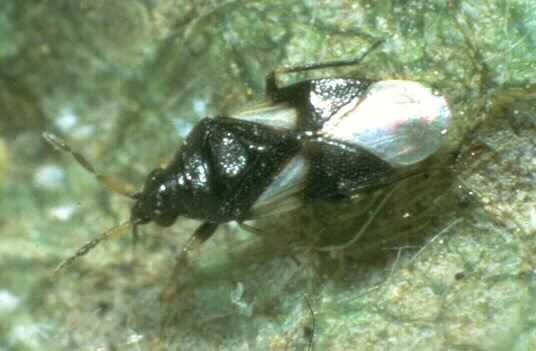
Orius insidiosus, or the Minute Pirate Bug, is a general predator that targets thrips, mite, aphid, small caterpillars & other soft-bodied insects. Favorable conditions are moderate temperatures around 59° F, RH > 60%. Diapause occurs with day lengths < 12.5-14 hours. Orius can’t survive without prey or pollen, so it is best to release Orius after thrips populations have become established or when pollen is also available. If prey is abundant, Orius will kill more thrips than it needs to survive. If Cucumeris has been released prior to Orius, Orius will feed on Cucumeris to become established. Cucumeris populations will decline briefly and then recover as thrips populations decline. 250-5,000 per acre OR 1-2 per 40 sq ft OR 1-4 per plant. Orius should be released in two applications, two weeks apart, to overlap the adult and immature life stages.
Shipped Wednesday, order by previous Friday.
Cardboard vertical honeycomb holds 400 larvae ready to feed on pests as soon as they hit the plant. Honeycomb unit has paper on one side, organdy mesh on the other, with one larva in each cell. Larvae can walk as far as 7 miles, ranging up to 100 feet while looking for pests. During 2-3 weeks of life, one lone lacewing larva can consume 250 leafhopper nymphs , 300-400 aphids, 11,200 spider mites, 3,780 coccid scale crawlers or 6,500 scale eggs. Interfering ants, waxy coatings or hard shells on pests and low temperatures deter lacewings from dining on and destroying pests. Remove organdy mesh from a few cells at a time, turn over, tap larvae onto plants near pest hotspots. Release ~20 larvae per plant.
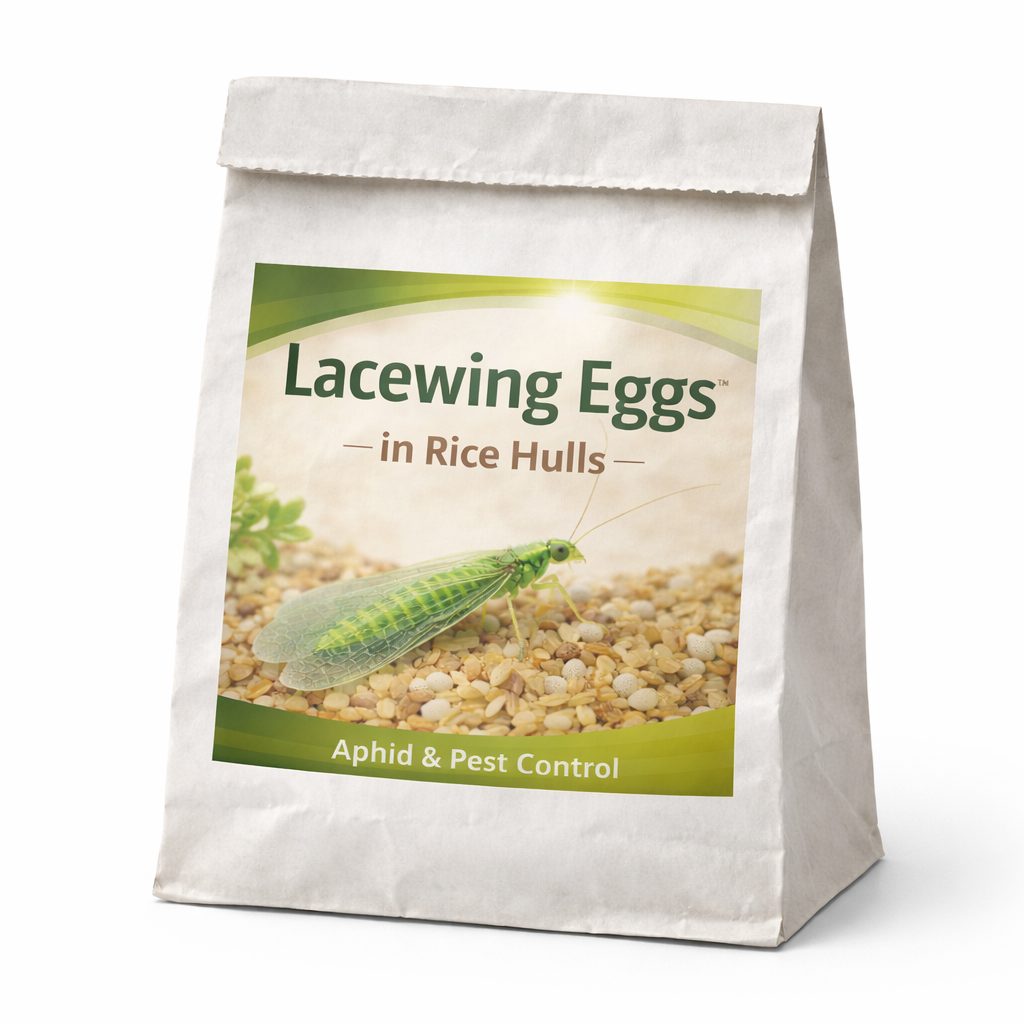
Eggs packaged in cups or bags of 1,000, 5,000 or 10,000 eggs per unit. Cups contain only the eggs and bags contain rice hulls as a carrier. Tiny larvae eat mites, mite eggs and insect eggs. Within about a week they start eating aphids. Release 2,000-3,000 eggs per acre every 2 weeks, 2-4 times OR 1 per 20 pests OR 2 per sq ft in greenhouses. Release when hatching begins: incubate cups or bags (ideal conditions 80º F, 60% RH), check each morning until tiny larvae appear in 1-4 days, sprinkle on plants directly or into paper cups placed in foliage.
Eggs packaged in cups or bags of 1,000, 5,000 or 10,000 eggs per unit. Cups contain only the eggs. Tiny larvae eat mites, mite eggs and insect eggs. Within about a week they start eating aphids. Release 2,000-3,000 eggs per acre every 2 weeks, 2-4 times OR 1 per 20 pests OR 2 per sq ft in greenhouses. Release when hatching begins: incubate cups or bags (ideal conditions 80º F, 60% RH), check each morning until tiny larvae appear in 1-4 days, sprinkle on plants directly or into paper cups placed in foliage.
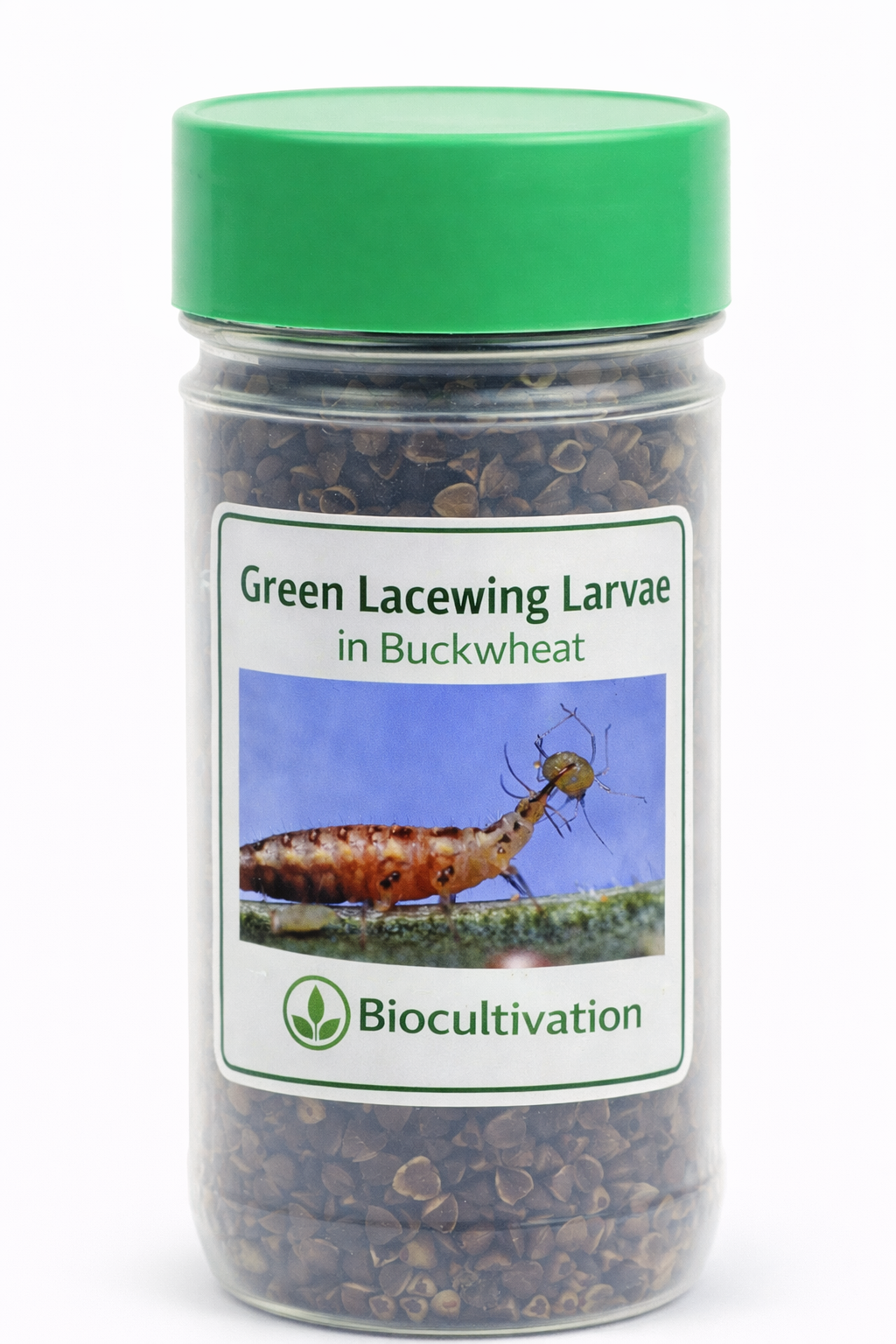
Lacewing larvae in buckwheat provide a powerful, ready-to-release biological control for a wide range of soft-bodied insect pests. The buckwheat hulls protect the larvae during shipping and help evenly distribute them when applied to plants or growing areas. Once released, the larvae immediately begin feeding on aphids, thrips, mites, mealybugs, and other common pests.
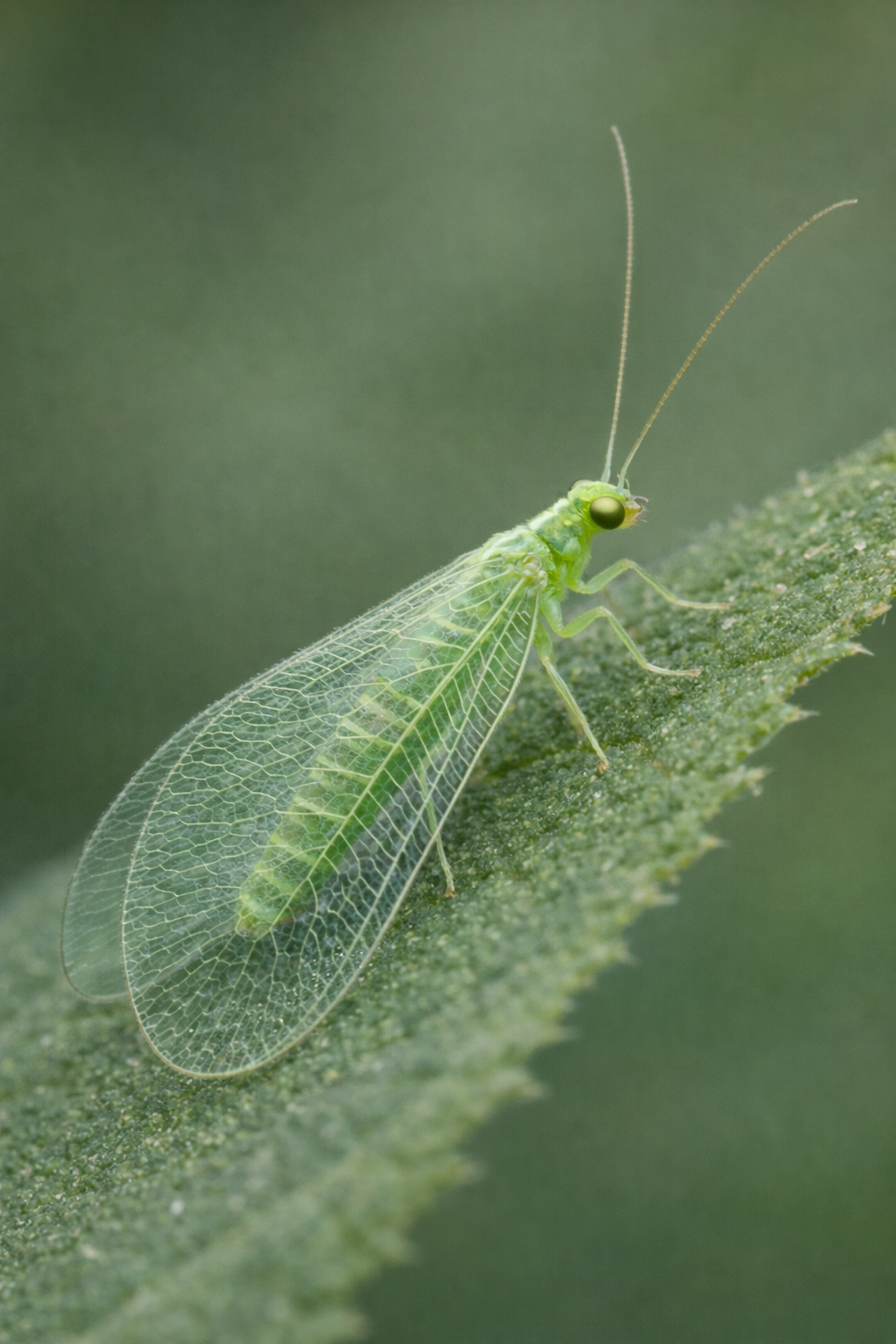
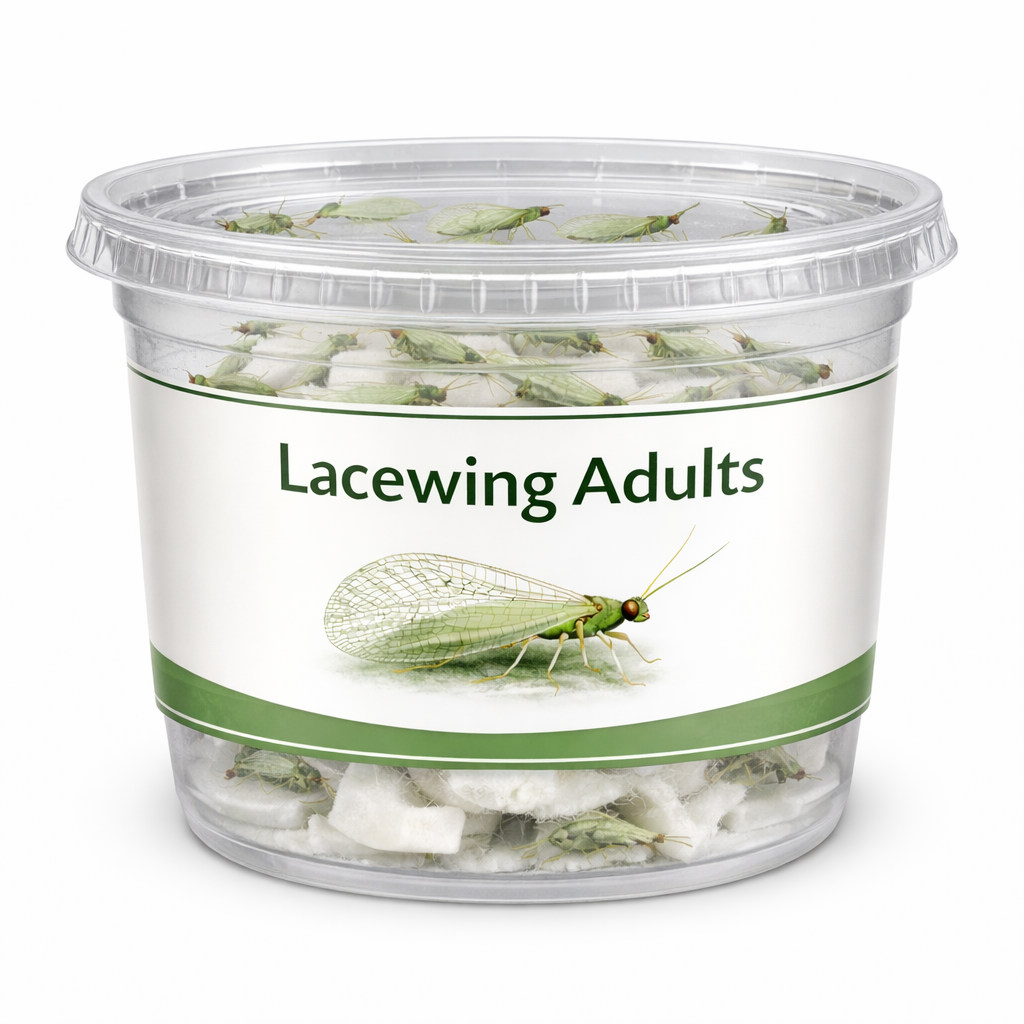
Lacewing Adults (Chrysoperla rufilabris) are released early in the season to establish a beneficial insect population and support long-term pest control by laying eggs that hatch into highly predatory larvae. Adult lacewings feed on pollen, nectar, and honeydew, acting as minor pollinators while each female lays up to 200 eggs to build ongoing control of aphids, mites, thrips, whiteflies, and other soft-bodied pests. Shipped in containers of 15,25, 100, 500, or 1000 and released the day of arrival, lacewing adults perform best at 67–90°F and should be used alongside ant management for successful aphid control.
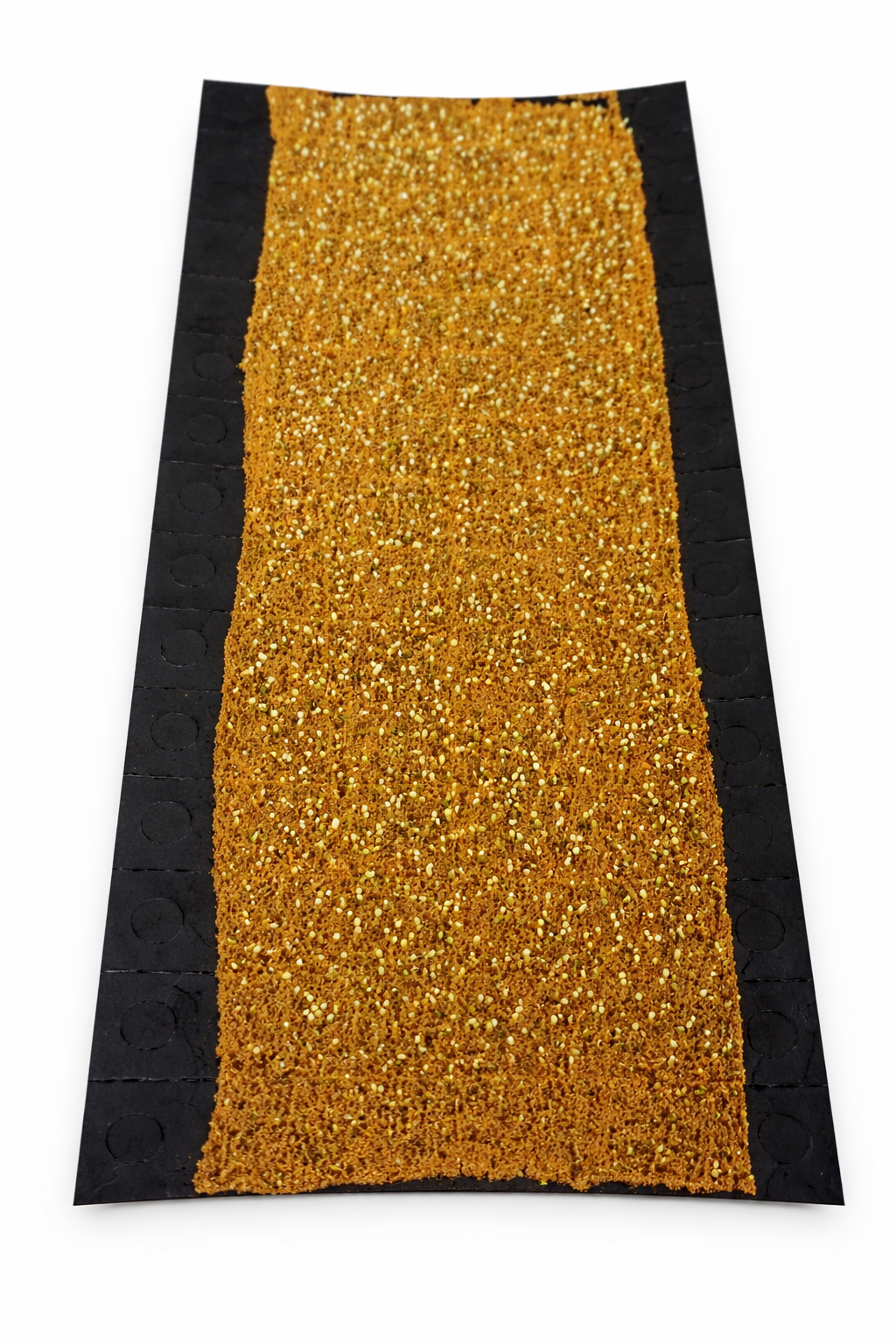
Lacewing on cards are shipped with 1,000, 2,500, 5,000 or 10,000 lacewing eggs glued on each card; cards are perforated to guide cutting or tearing into 30 of ¾ X 2 inch tabs with a hook on one end and containing about 86, 170 or 332 eggs. Cut and place tabs into vines, shrubs or trees when larvae begin to hatch. Tabs can also be placed inside small paper cups and either stapled to plants or hung by a knotted string (through bottom of cup). The cards can be further cut into smaller pieces for wider distribution.

Amblysieus cucumeris (=Neoseiulus cucumeris) is a predatory mite shipped in bran carrier. Targets western flower thrips, onion thrips, and to a lesser extent, spider, cyclamen and broad mites. Nymph and adult stages feed on immature stages of thrips, so a decrease in adult thrips populations will show 3 weeks or so after release. Adults also feed on twospotted spider mites and their eggs. Cucumeris takes 3-4 weeks to establish, so it should be applied before thrips populations appear. Cucumeris also feeds on pollen as an alternate food source. Ideal conditions are 66°-80° F, 65-72% RH. Day lengths less than 12.5 hours with night temperatures less than 70° F induce diapause unless supplemental light is provided.
Shipped Wednesday, order by previous Friday