
DIY Non-Toxic Ant Bait
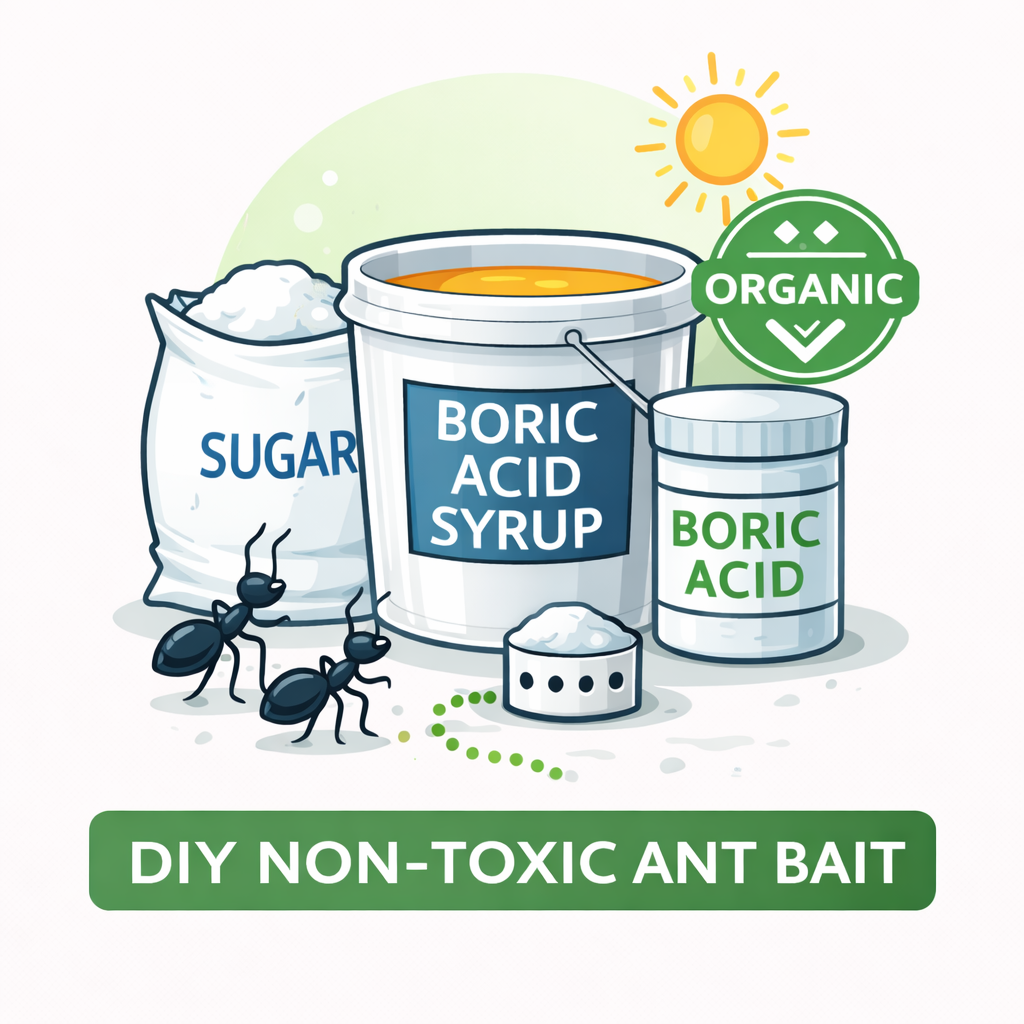
Boric Acid & Borax Ant Bait Recipes
Liquid ant baits made with borates (boric acid or borax) are one of the most effective low-toxicity tools for managing ant populations outdoors. When properly diluted and placed in secure bait stations, foraging ants carry the bait back to the colony, where it is shared with nestmates and the queen. This slow-acting approach allows for colony-level control, rather than simply killing individual ants.
Borates are naturally mined materials and are generally acceptable for use in organic pest management programs. Always confirm allowed materials and application methods with your organic certifier.
Why Liquid Borate Baits Work
Ants are attracted to sugars for energy. By combining sugar with a low concentration of a slow-acting borate, worker ants are able to feed normally and return to the nest without being repelled or killed too quickly. Over time, repeated feeding reduces the colony.
Key principles:
Low concentration is critical (stronger is not better)
Liquid bait is shared throughout the colony
Results take time—typically several weeks
Strategic placement matters more than quantity
DIY Boric Acid Syrup (1% Boric Acid in 25% Sugar Syrup)
This is a commonly used formulation for outdoor ant baiting.
Small-Volume Recipe
Ingredients
1 cup sugar
2 cups water
2 level teaspoons boric acid
Instructions
Heat the water slightly to help dissolve ingredients.
Stir in sugar until fully dissolved.
Add boric acid and stir thoroughly.
Allow to cool before placing into bait stations.
Large-Volume Recipe (2 Gallons of Bait)
Designed for filling multiple bait stations (e.g., AntPro®-style dispensers).
Ingredients
Water: 2 gallons
Sugar: 5 pounds
Boric acid: 0.215 pounds (3.44 oz)
Instructions
Add warm water to a clean 5-gallon bucket.
Slowly mix in sugar until fully dissolved.
Add boric acid and stir until completely dissolved.
Use immediately or store sealed and labeled.
DIY Borax Ant Bait (5% Borax in 25% Sugar Syrup)
Borax (sodium borate) contains a similar amount of borate as boric acid. A 5% borax solution delivers roughly the same borate concentration as a 1% boric acid solution.
Borax Recipe (5 Gallons Total)
Ingredients
Sugar: 10 pounds
Borax: 2 pounds
Water: Enough to make 5 gallons
Instructions
Dissolve sugar in warm water.
Add borax slowly while stirring.
Mix until fully dissolved and uniform.
Bait Station & Placement Guidelines
Use sealed bait stations with entry holes around 1/8 inch
Entry holes should allow ants in but exclude bees and butterflies
Secure bait stations so dogs, cats, and children cannot access them
Place stations outdoors along ant trails or near foraging areas
Do not pour bait directly onto soil
⚠ Important:
Boric acid in more than trace amounts can be toxic to plants. Avoid spills, pooling, or dumping bait onto the ground.
Organic Use Considerations
Borates (boric acid and borax) are naturally mined materials
Commonly allowed in organic pest management programs
Always verify product use, concentration, and application method with your certifier
Commercial Option: Gourmet Liquid Ant Bait
For users who prefer a ready-to-use option, Gourmet Liquid Ant Bait is an NOP-listed organic product formulated for consistent results in bait stations.
Ready-to-use liquid bait
Compatible with AntPro® and similar dispensers
Demonstrated ~80% control of Argentine ants within 6 weeks
Available from Rincon-Vitova Insectaries
Powdered boric acid is also available for customers who wish to prepare their own bait formulations.
Final Notes
Liquid ant baiting is a patience-based strategy. Avoid using fast-acting insecticides near bait stations, as these can disrupt foraging behavior and cause colonies to relocate rather than collapse.
For best results, combine:
Proper bait concentration
Secure, weather-protected bait stations
Strategic placement
Consistent monitoring