
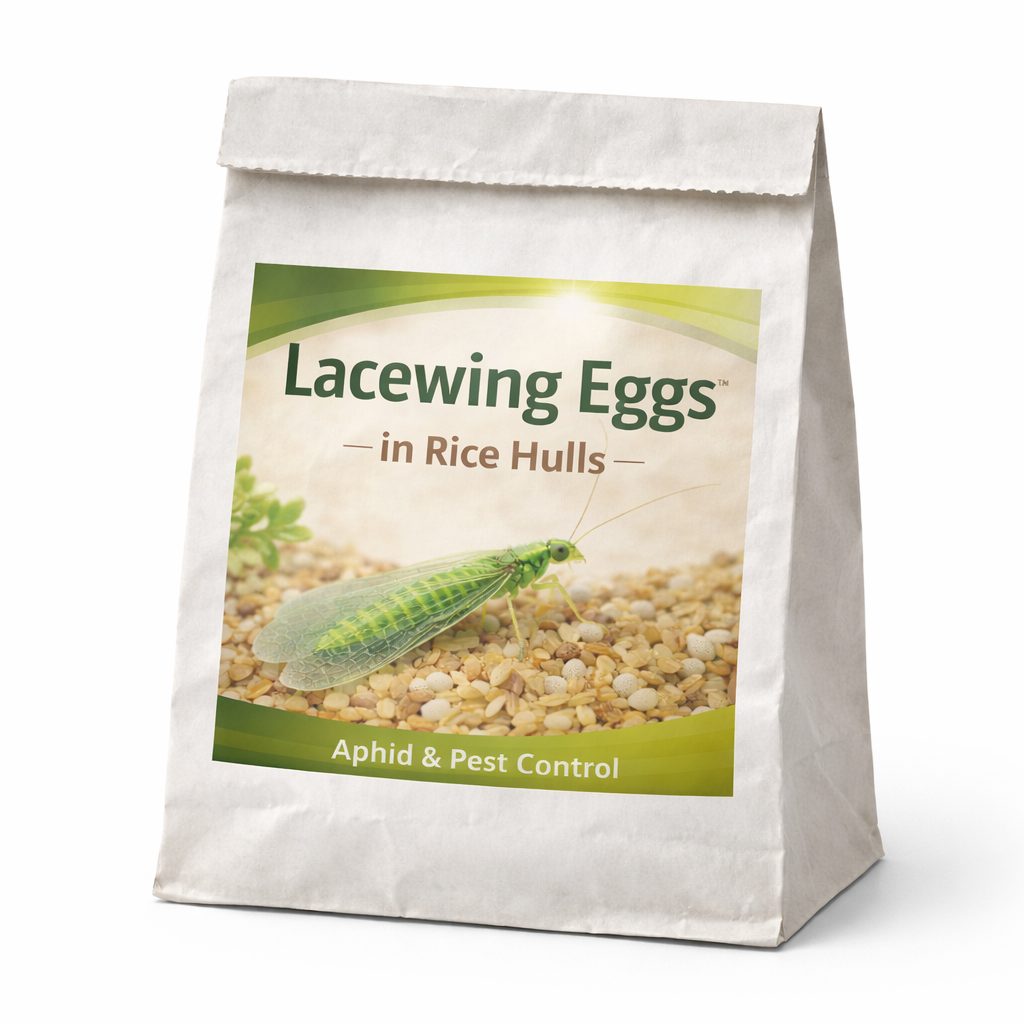
Lacewing Eggs with Rice Hulls
Eggs packaged in cups or bags of 1,000, 5,000 or 10,000 eggs per unit. Cups contain only the eggs and bags contain rice hulls as a carrier. Tiny larvae eat mites, mite eggs and insect eggs. Within about a week they start eating aphids. Release 2,000-3,000 eggs per acre every 2 weeks, 2-4 times OR 1 per 20 pests OR 2 per sq ft in greenhouses. Release when hatching begins: incubate cups or bags (ideal conditions 80º F, 60% RH), check each morning until tiny larvae appear in 1-4 days, sprinkle on plants directly or into paper cups placed in foliage.

Additional Info
Green Lacewing Larvae in Rice Hulls (Chrysoperla rufilabris)
Green lacewings are one of the most versatile, broad-spectrum beneficial predators available. Chrysoperla rufilabris larvae attack a wide range of soft-bodied pests and their eggs, including aphids, whiteflies, thrips, mites, scale crawlers, mealybugs, psyllids, leafhopper nymphs, and small caterpillars/egg masses. The feeding stage is the larva—a grayish-brown “mini-alligator” with pincer-like jaws that grabs prey, injects digestive enzymes, and then feeds by sucking out the contents. In practical terms: lacewing larvae are fast-moving hunters that can clean up scattered pest colonies and hot spots when conditions are right.
What “in rice hulls” means (and why it matters)
This product format uses rice hulls as a carrier/dispersal material to help you distribute lacewings quickly and evenly through plant canopies. Rice hulls are lightweight, flow well, and help separate eggs/young larvae so they don’t clump—especially useful for ornamentals, gardens, interiorscapes, small farms, and greenhouse crops. It’s an easy “sprinkle/broadcast” option for getting predators close to the pest.
Lifecycle and what to expect after arrival
At warm temperatures (around 80°F / 27°C), lacewing larvae typically emerge from eggs in ~3–5 days from the shipping date. Temperature strongly affects speed and appetite: higher temps increase metabolism and feeding rate (and can shorten the time needed to knock down aphids), while cooler conditions slow activity. As a rule of thumb, ~60°F (15.5°C) or warmer is needed for significant feeding and adult egg-laying.
Once hatched, larvae are active predators for roughly two weeks (often longer when nights are cool). After feeding, they spin cocoons and adults emerge in about ~5 days under warm conditions. Adults are not pest-eaters—they’re primarily nectar/pollen/honeydew feeders—but they support ongoing control by laying more eggs. Each adult can lay hundreds of eggs (often cited as up to ~600), placed on tiny filament “stalks” to reduce cannibalism.
Why lacewings are so effective
Lacewing larvae are exceptionally efficient predators. Over their development, a single larva can consume hundreds of aphids, large numbers of mites and other small pests, and substantial quantities of eggs/crawlers depending on the crop and pest. They also move—larvae can travel surprisingly far and will move plant-to-plant when foliage touches, making them useful when pest colonies are scattered.
Release timing and strategy (keys to success)
Lacewings work best when you start early and repeat releases to keep the predator stage present as pest generations overlap. Many effective programs use 2–4 releases, spaced 7–14 days apart, especially during rapid pest buildup.
General guidelines (adjust based on crop density, pest pressure, temperature, and other natural enemies):
Greenhouse flats (aphids): ~5–20 hatching eggs per square yard
Orchards / row crops: ~2,000–30,000 hatching eggs per acre, repeated 2–4 times every 7–14 days
Predator:prey rules of thumb:
Slow-growing plants: ~1 larva per 50 prey
Fast-growing plants: ~1 larva per 10 prey
Practical approach: treat hot spots and edges aggressively (where outbreaks often begin), then expand coverage if monitoring shows spread.
Handling instructions (so you don’t lose hatch)
To get the best hatch and survival:
Keep warm: 75–90°F (24–32°C), out of direct sun, and away from heaters/fans that dry air
Maintain moderate humidity (~30–50% RH) with airflow (avoid sealed plastic)
Check daily; release within 24 hours of first hatch if possible
If no hatch within ~5 days at warm temps, that’s a troubleshooting signal
Release during cool parts of the day (early morning/evening), ideally onto lightly misted foliage
When distributing: sprinkle into foliage close to pest colonies and spread widely—lacewings are effective, but coverage matters.
Ants can sabotage lacewing performance
If your target pests produce honeydew (aphids, mealybugs, soft scale, whiteflies), ants often protect those pests and may eat lacewing eggs or harass larvae. Ant management is frequently the difference between “okay results” and “wow.” If ants are present, pair lacewings with an ant strategy (barriers, baits, or other IPM tools) so predators can do their job.
When to choose eggs vs. pre-fed larvae
Eggs in rice hulls (this product): great for broad coverage, preventative releases, and easy distribution across many plants.
Pre-fed larvae (honeycomb units): best for immediate knockdown and hot spot treatments (they get a “head start” and are less vulnerable than eggs).